

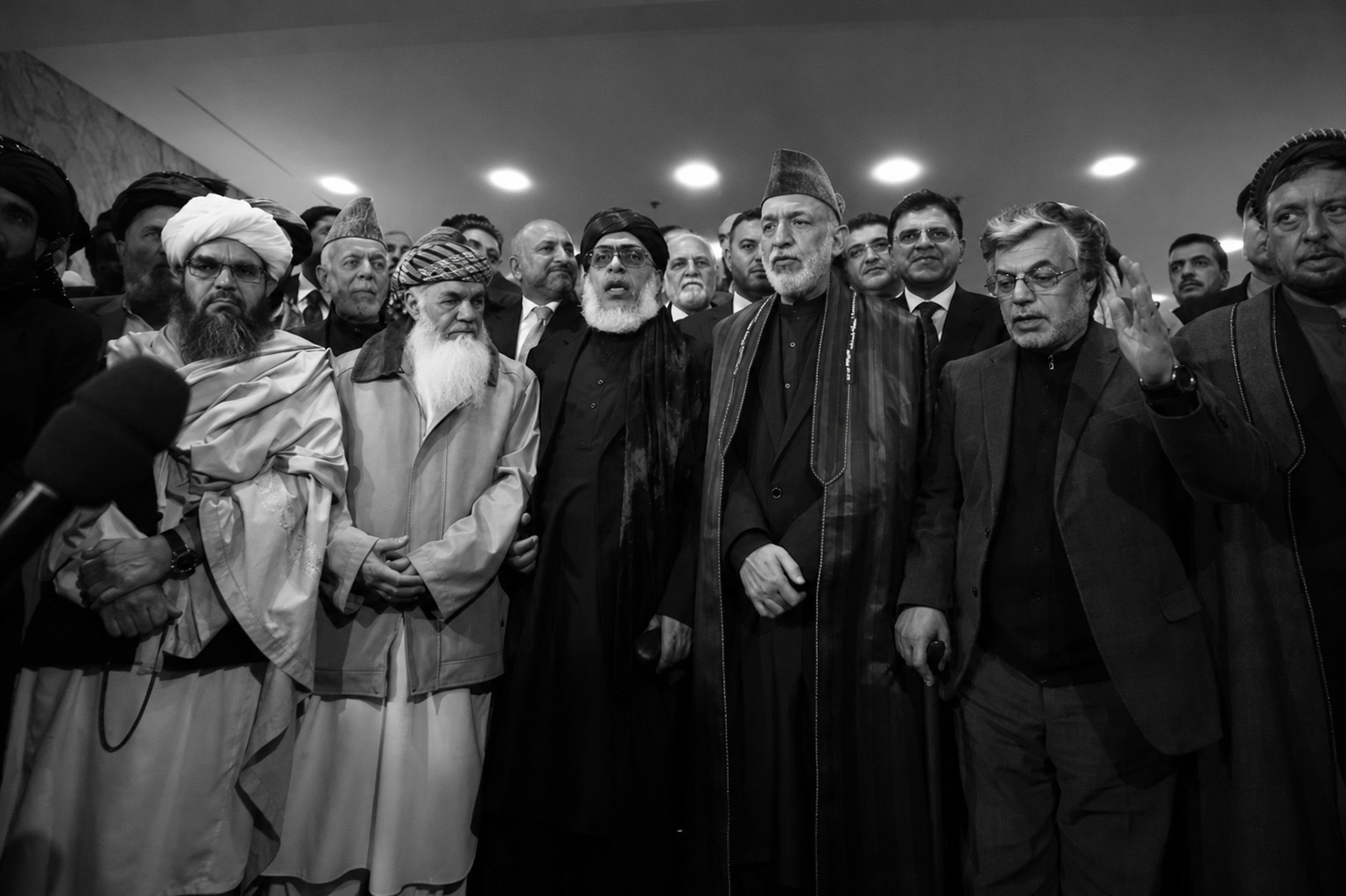
In Afghanistan’s contemporary political history, 1992 was not merely the year a government fell. It marked the collapse of a century-long historical continuity that had endured despite repeated changes in political systems. From the Emirate to the Monarchy, from the Republic to the Democratic Republic, the Afghan state preserved its legal identity, institutional continuity, and international personality. After the disastrous events of 1992, however, the state was gradually replaced by networks of power, armed factions, and an NGO-driven political class.
For this reason, I use the term “power ecosystem” to describe Afghanistan’s political order over the past thirty-four years.
By this concept, I refer to the political structure composed of former warlords, factional leaders, mujahideen figures, liberal technocrats, individuals educated within Western intellectual and policy institutions, and political actors who emerged through the international aid and NGO sector. Although governments have changed repeatedly, these actors have remained directly or indirectly at the center of political influence and power.
The defining characteristic of this ecosystem is not that its members always hold official government positions. Rather, it is their remarkable ability to preserve their economic, political, and even military influence regardless of who governs. At different times they appear as government officials, opposition leaders, peace negotiators, advocates of national consensus, or international partners, yet the underlying structure of power remains fundamentally unchanged.
This explains why Afghanistan’s political crises have rarely been resolved simply by replacing one group of leaders with another.
Today, many representatives of this same political class present themselves as the only viable alternative to the Taliban, arguing that any future political settlement must revolve around them. This claim deserves careful scrutiny, because these very actors played direct or indirect roles in the major political decisions of the past three decades, including the design of the state, the distribution of power, and the weakening of national institutions.
Therefore, Afghanistan’s future depends not only on answering the question, “Who comes after the Taliban?” An even more important question is: “Will the same political ecosystem return to power under new names and new slogans?”
The experience of the five years since 2021 offers Afghanistan’s younger generation an important opportunity to examine this question critically.
Although members of this political class no longer hold formal government authority, they continue to enjoy substantial financial resources and operate freely both inside Afghanistan and abroad. Their consistently lavish lifestyles, their continued political activities from luxurious residences and well-funded offices, and their sustained influence across traditional and social media raise legitimate questions: Where does their financial power come from? Who finances their political activities? And how has their influence endured long after they left formal office?
Between 2002 and 2021, Afghanistan’s laws required senior government officials to register their assets through the Administrative Office’s Office for the Registration and Assessment of State Officials’ Assets. Comparing those official declarations with present-day realities raises an obvious question. How have individuals who officially reported only modest personal wealth managed to sustain expensive lifestyles and extensive political operations for the past five years, despite losing their government positions and official privileges? Based on their declared assets, many would not have been able to finance even a single month of their current standard of living.
At the same time, Afghanistan’s younger generation must avoid repeating another historic mistake.
Over the past three decades, Afghan politics has revolved largely around personalities rather than institutions. Every crisis was expected to be solved by the arrival of another “strong” or “influential” individual, while lasting institutions were never built. Faces changed, but the logic and structure of power remained the same.
If the new generation merely chooses between competing factions within these same old networks, Afghanistan risks reliving the failures of the past thirty years.
The younger generation should also recognize that the post-1992 power ecosystem has not survived solely through its internal actors. Its external backers have, in many respects, overlapped with those supporting the Taliban. Regionally, Pakistan, and globally, the United States, have been among the most influential external players involved in shaping—and repeatedly reshaping—this political ecosystem.
Even today, as discussions continue in Pakistan and the West about organizing a post-Taliban opposition, many of the same external sponsors associated with this ecosystem remain deeply involved. Consequently, opposing the Taliban alone does not automatically produce an independent or genuinely new political alternative.
Past experience also suggests that these external supporters may once again present Afghanistan’s youth with an appealing vision of change, freedom, democracy, and political participation as part of efforts to reconstitute and restore this same ecosystem to power. Yet the experience of the last three decades demonstrates that in such processes, young people and the broader public rarely become the true owners of political power or decision-making. Instead, they are often mobilized primarily to confer legitimacy on the same political actors. Real power and decision-making remain concentrated within a narrow circle of political networks and their foreign sponsors, while the public is once again left with the role of providing support and legitimacy rather than genuine ownership.
For this reason, the central focus of Afghanistan’s future political struggle should not be support for—or opposition to—particular individuals. It should be the standards by which political legitimacy is judged.
Every political movement—whether pro-Taliban or anti-Taliban, whether rooted in the jihad era, the technocratic elite, or organized grassroots politics—should be evaluated according to the same criteria: accountability for its record in power, respect for the rule of law, commitment to Afghanistan’s national interests, and a demonstrated record of state-building.
Afghanistan does not need new slogans. It needs new standards of political conduct and political ethics.
As long as political power continues to be defined by exclusive networks, personal loyalties, and informal bargains, changing governments will not improve the lives of ordinary Afghans. Instead, it will continue to reproduce the same cycles of instability and disappointment.
Afghanistan’s problem is not simply the existence of one particular government or one particular political faction. The deeper problem is the persistence of the political ecosystem that has survived since 1992, preserving its essential character even as its individual actors have changed.
Accordingly, the historic responsibility of Afghanistan’s new generation is not to legitimize one faction of this ecosystem against another. Its responsibility is first to understand the ecosystem itself—its structure, the mechanisms that sustain it, and the consequences of becoming part of it. Joining this ecosystem does not offer a path out of Afghanistan’s political crisis; it merely guarantees the continuation of the post-1992 political order.
Only when politics is organized around institutions rather than personalities, around the rule of law rather than political bargains, and around public accountability rather than private networks, will Afghanistan take its first genuine step toward resolving its long-standing political crisis.
Afghanistan’s future does not lie in the return of familiar faces. Its hope rests in a new political generation committed not to preserving the post-1992 power ecosystem, but to rebuilding the Afghan state itself.