

History, for better or worse, has a strange tendency to repeat itself. Nations that fail to learn from their past experiences and mistakes often pay a heavy historical price. Throughout history, there have been many instances where ignoring past failures and lessons has come at such a high cost that correcting them later became extremely difficult, and in some cases, impossible.
In the nineteenth century, Afghanistan fell behind the great transportation revolution. While railways were connecting countries and markets across much of the world, facilitating trade and strengthening state institutions, Afghanistan remained outside the emerging railway network. Falling behind this great transformation was the result of a combination of domestic factors and external geopolitical rivalries.
Afghan rulers at the time, including Amir Abdur Rahman Khan, feared that railways could become a tool for foreign powers to invade and occupy Afghanistan. At the same time, the rival empires of the Great Game, the British Empire and Tsarist Russia, saw little strategic benefit in the emergence of a strong, connected, and modern Afghanistan. For them, an isolated and weakened Afghan state was more acceptable than a prosperous Afghanistan integrated with its region.
The consequences were profound and damaging. Afghanistan gradually became disconnected from regional trade, industrial development, and technological progress. The Industrial Revolution that transformed Europe, North America, and large parts of Asia largely passed Afghanistan by. Repeated foreign invasions, internal wars, weak state institutions, limited investment in education, and recurring foreign interference widened the gap even further.
Today, we are once again standing on the threshold of another great global transformation, the revolution driven by artificial intelligence. Artificial intelligence, advanced computing, biotechnology, robotics, and digital infrastructure are transforming the world as fundamentally as railways and factories did in the nineteenth century.
Unfortunately, Afghanistan once again faces a serious risk of missing this historic transformation. Over the past five years, the policies of the Taliban have deepened our national isolation. Banning girls from secondary and higher education, excluding women from public life and employment, suppressing academic and intellectual freedom, censoring modern education, and subordinating education and thought to a rigid ideology are systematically destroying Afghanistan’s most important strategic asset: its human capital.
At a time when knowledge has become the world’s most valuable resource, the Taliban are depriving millions of Afghans of opportunities to learn and advance. By excluding half the population, women, from education and productive work, Afghanistan is once again being pushed off the path of progress.
No society can achieve technological advancement by fearing knowledge, restricting free inquiry and independent thought, and replacing critical thinking with ideological obedience. The cost of these policies will not be limited to today’s poverty; they will have dangerous consequences for generations to come.
All of this is happening while the global technological revolution is advancing at unprecedented speed. Artificial intelligence is rapidly becoming a fundamental pillar of economic growth, military capabilities, scientific discovery, healthcare, education, and governance. Countries around the world are investing heavily in scientific research, digital infrastructure, and the education of their young people.
The countries leading this revolution will also have a profound influence on the global order of the twenty-first century. Afghanistan, however, risks becoming increasingly isolated from this historic transformation.
In 2018, when I was an adviser to President Mohammad Ashraf Ghani, I was given responsibility for overseeing and coordinating the launch and implementation of Afghanistan’s electronic national identity card, or e-Tazkira.
This was not simply a project to introduce a new identity document. It was the foundation for Afghanistan’s digital transformation and for building a modern digital state.
The national initiative faced unprecedented resistance. Some Afghan political figures, particularly Dr. Abdullah Abdullah and former President Hamid Karzai, strongly opposed the process. At the same time, important actors within the international community, including the United States and the United Nations, also opposed the launch of the electronic identity card.
The political pressure, administrative obstacles, and security threats were extremely serious. Despite all these challenges, and despite pressure and threats from both domestic and international actors, I was able to coordinate the process and successfully launch the national e-Tazkira program in early 2018.
The process was so significant that even today, the Taliban regime presents the distribution of the electronic identity card process that we initiated as one of its major achievements.
Perhaps this is one of Afghanistan’s great misfortunes: every major step toward modernization faces resistance. But this experience also demonstrated another important truth: when political leadership places the national interest above short-term political calculations, progress is possible.
Later, when I became Director General of the Office of Administrative Affairs, I initiated the implementation of Afghanistan’s e-governance program. The first practical step was the e-Cabinet initiative. Through this system, Afghanistan’s Cabinet proceedings were conducted digitally for the first time.
The e-Tazkira is now a successful Afghan experience. Yet the development of digital infrastructure, technological capacity, modernization of state institutions, scientific advancement, and investment in human resources have all deteriorated significantly since the Taliban came to power.
The Taliban’s worldview is fundamentally at odds with many of the conditions necessary for participating in the knowledge and technology revolution. No country can build an AI-driven economy while girls are excluded from schools and universities, women are removed from a large part of the workforce, academic freedom is restricted, independent thought is suppressed, and access to modern knowledge is limited.
This is not merely a human rights issue. It is a direct obstacle to national development and technological advancement.
An illegitimate regime is now in power in Afghanistan. It is a regime that excludes a large portion of the country’s population from political, economic, educational, and social participation and governs without a genuinely representative and inclusive political process.
Such an illegitimate system cannot mobilize the talent, creativity, and intellectual capacity of the Afghan people. Nor can it build the international relationships, investment, scientific partnerships, and technological networks that are essential in the age of artificial intelligence.
Afghanistan therefore faces the danger of entering a deeply damaging cycle. Ideological isolation produces political isolation; political isolation leads to economic and technological isolation; and technological isolation, in turn, makes us increasingly dependent on the outside world.
Our close neighbor China is now one of the world’s leading technological powers, making unprecedented investments in artificial intelligence, advanced manufacturing, and digital infrastructure.
Yet Afghanistan is moving in the opposite direction.
Afghanistan’s geography should naturally have made it an important bridge connecting Central Asia, South Asia, the Middle East, and China, one of the world’s major technological centers. But geography alone does not create prosperity.
Unless we have an educated population, skilled professionals, modern institutions, scientific research, reliable digital infrastructure, and an environment in which innovation and technology can flourish, Afghanistan will not benefit from this historic transformation.
Colonial powers did not obstruct Afghanistan’s development only through direct occupation. In many cases, they saw strategic advantage in keeping Afghanistan politically isolated and weak, economically underdeveloped, and strategically dependent in different spheres.
At various points in our history, Afghanistan’s transit routes, commercial ties, and regional connectivity were restricted because of the strategic interests of competing empires.
As mentioned earlier, the railway question is one of the clearest historical examples of this problem. The British Empire’s primary concern was preventing Russian expansion and influence toward India, and it largely viewed Afghanistan as a buffer between British India and the Russian Empire.
Neither empire saw a strategic benefit in transforming Afghanistan into an independent regional transportation and commercial hub. In fact, this geopolitical situation not only worked against such development but also constrained the initiatives of Afghan rulers.
Of course, Afghan rulers also played their part. Given Afghanistan’s history of repeated foreign invasions, the fear that railways could be used as an instrument of invasion was understandable.
But the result was that Afghanistan remained outside one of the great revolutions of the nineteenth century.
It is important that we understand and acknowledge that foreign invasions and interference have repeatedly had a negative impact on Afghanistan’s development. But we must also be honest with ourselves: foreign intervention alone cannot explain all of our failures.
At many critical moments in our history, Afghan rulers, political leaders, and competing factions have also prioritized short-term political interests, extremism, personal rivalries, and internal divisions over long-term national development.
Whether these conditions were encouraged from outside, generated internally, or resulted from an interaction between the two, the outcome was the same: the world moved forward while Afghanistan fell further behind.
This should therefore serve as a wake-up call for the entire Afghan nation.
The defining competition of the twenty-first century will not be only over land and geography. It will increasingly be a competition over knowledge, technology, innovation, information, scientific capacity, and human capital.
Our initiative must begin with the creation of an independent Afghan political process; one that is accountable to the people of Afghanistan, free from foreign domination and ideological extremism, and guided by a long-term national vision.
We need a politics that places education above extremism, science above prejudice, institutions above individuals, merit above connections, and national interests above group loyalties.
We must reconnect Afghanistan physically and digitally with our neighbors and with the wider world.
For the Afghanistan of the future, it is no longer acceptable for our country to be merely landlocked in a physical sense. We must not become technologically landlocked and isolated as well.
Afghanistan needs modern roads and railways, reliable electricity, telecommunications, widespread internet access, data infrastructure, digital public services, technology companies, scientific research centers, and, most importantly, educated young people, both women and men, who can participate in the global knowledge economy with competitiveness and dignity.
This is not merely an economic agenda. It is a strategy for national survival.
And this responsibility does not belong to a single government, political group, or generation. It is the shared responsibility of the entire nation to develop the national commitment, strategic patience, political courage, and long-term vision necessary to look beyond today’s political crises and see the future that lies ahead.
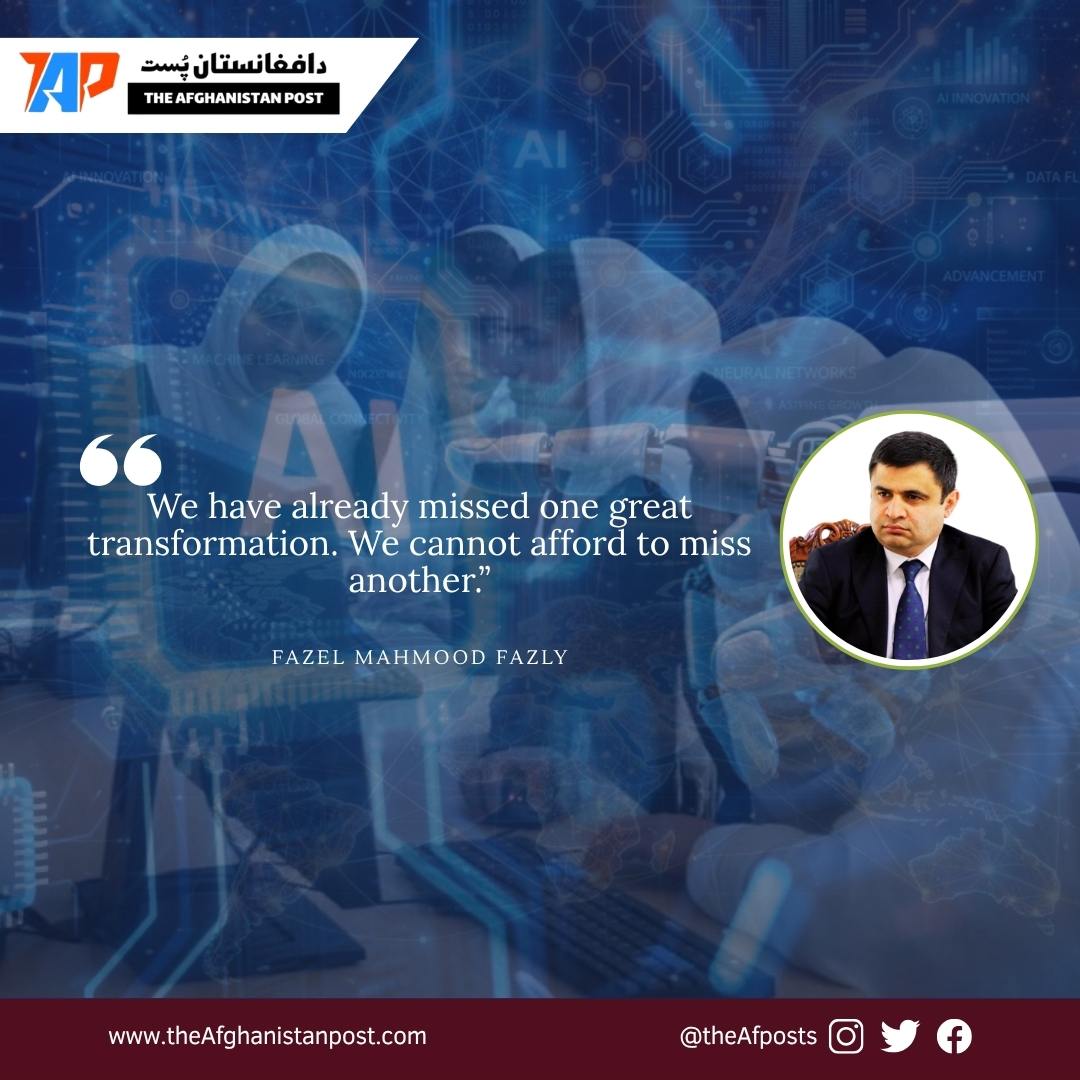
We have already missed one great transformation. We cannot afford to miss another.
Afghanistan fell behind the great transportation revolution. Afghanistan fell behind the Industrial Revolution. We must not allow ourselves to miss the revolution in knowledge, technology, and artificial intelligence as well.
If we fail once again, Afghanistan will not simply remain a poor country. In a world where economic power, political influence, security, and international standing are increasingly determined by knowledge, technology, and innovation, Afghanistan will gradually lose its importance and influence.
Future generations will rightly ask us: Why did a nation situated at the crossroads of Asia, a nation that has repeatedly found itself at the crossroads of great historical transformations, allow itself to become isolated from another great global transformation?
Today, the choice before us is clear.
We can continue down the path of isolation, backward-looking policies, extremism, technological underdevelopment, and political fragmentation.
Or we can build an Afghanistan founded on education, knowledge, independent thought, equal opportunity, innovation, connectivity, and national independence.
We need an independent Afghan political process that is genuinely independent, not a political order designed in foreign capitals, not a government dependent on foreign powers, and not a system controlled by armed reactionaries or ideological groups rooted in the medieval past.
This is a struggle for knowledge against ignorance, science against prejudice, connectivity against isolation, progress against stagnation, and national independence against dependency.
History has shown us that we have already paid the price for missing great transformations.
Today, however, we face another warning from our own history.
What Abdur Rahman Khan could not do, we can do.
But if we fail to act today, God forbid, we may once again miss a revolution whose consequences will be many times greater, and potentially far more dangerous, than those of the Industrial and transportation revolutions.