

The recent remarks by Uzbek President Shavkat Mirziyoyev describing the Trans-Afghan Corridor as vital for regional prosperity reminded me of discussions that began more than eight years ago. I had the privilege of participating in some of those discussions as a member of the Afghan government and witnessed firsthand both the promise of the project and the obstacles that have repeatedly stood in its way.
In March 2018, I accompanied President Ashraf Ghani during discussions with President Mirziyoyev regarding what would later become known as the Trans-Afghan Corridor. A comprehensive blueprint was presented outlining a strategic vision to connect Central Asia to South Asia and the Indian Ocean through Afghanistan.
The proposal was ambitious but realistic. It reflected a shared understanding that Afghanistan’s geography could become an economic asset rather than a source of vulnerability. For Uzbekistan and other Central Asian states, Afghanistan represented the shortest route to warm-water ports and global markets. For Afghanistan, the corridor offered an opportunity to become a regional transit hub linking Central and South Asia.
The Afghan government fully embraced the initiative. We expressed readiness to cooperate in every aspect of the project, including participation in feasibility studies and financial contributions. Afghanistan was prepared not merely to host the corridor but to become an active partner in its development.
However, even during those early discussions, we expressed concerns regarding Pakistan’s willingness to facilitate the project. While our Uzbek colleagues remained optimistic that Islamabad would ultimately support regional connectivity, we were less certain. We understood that the success of the corridor depended not only on economics but also on political decisions in Pakistan.
Subsequent events would unfortunately prove those concerns justified.
The Wagah-Attari Question
The most significant obstacle to a fully functioning Trans-Afghan Corridor has always been Pakistan’s refusal to permit unrestricted overland connectivity between Afghanistan and India.
I witnessed this challenge firsthand during President Ghani’s visit to Pakistan on June 27, 2019, which I attended as part of the Afghan delegation.
During bilateral discussions, President Ghani raised a proposal that could have transformed regional connectivity: opening the Wagah-Attari border crossing to facilitate broader Afghan-Indian trade. Such a decision would have removed one of the most significant barriers to the Trans-Afghan Corridor and signaled Pakistan’s commitment to regional economic integration.
Present at the meeting were Prime Minister Imran Khan, Chief of Army Staff General Qamar Javed Bajwa, ISI Director General Faiz Hamid, and Foreign Minister Shah Mahmood Qureshi.
Prime Minister Imran Khan appeared receptive. He immediately welcomed the proposal, and discussions moved toward the possibility of announcing the breakthrough during a joint press conference.
Yet the announcement never came.
During the meeting, General Bajwa passed a written note to the Prime Minister. Shortly afterward, plans for the joint announcement were abandoned. The press conference did not take place, and no agreement on Wagah-Attari access was reached.
For those of us present, the episode was revealing. It illustrated how decisions concerning regional connectivity were ultimately subordinated to the calculations of Pakistan’s security establishment. Economic logic, regional prosperity, and commercial opportunity gave way to security establishment’s considerations.
A Second Setback After 2021
While Pakistan’s policies have undoubtedly been a major obstacle, it would be incomplete to discuss the challenges facing the Trans-Afghan Corridor without acknowledging developments inside Afghanistan after August 2021.
The collapse of the Islamic Republic of Afghanistan created a second significant challenge to the project’s implementation.
Large-scale international infrastructure projects require more than geography and political declarations. They require a legitimate and internationally recognized government capable of entering binding agreements, providing legal guarantees, ensuring transparency, and maintaining investor confidence.
Today, Afghanistan is governed by a regime that remains unrecognized by the international community and whose domestic legitimacy continues to be contested by large segments of Afghan society. Regardless of individual political views, this reality creates serious practical obstacles for major infrastructure investments.
Even if Uzbekistan and some regional actors are prepared to engage with the Taliban, international financial institutions, insurance providers, commercial lenders, and private investors operate according to different standards. Major railway and transit projects require political risk insurance, sovereign guarantees, dispute-resolution mechanisms, and long-term legal certainty.
Without these safeguards, attracting the scale of investment necessary for the Trans-Afghan Corridor becomes extremely difficult.
As a result, the project today faces a dual challenge: external political obstacles originating in Pakistan and internal governance challenges resulting from Afghanistan’s lack of internationally recognized and legitimate state institutions.
A Third Challenge: Persistent Insecurity Driven by Proxy Extremist Groups
Beyond political and governance obstacles, the Trans-Afghan Corridor faces a third major challenge: persistent insecurity along the Durand Line.
For decades, extremist militant groups nurtured and supported by Pakistan’s security establishment have operated in the region, using it as a base for violence and destabilization. These groups have carried out attacks against Afghan civilians, security forces, public infrastructure, and economic projects, creating an environment of chronic insecurity.
The proposed corridor would depend heavily on secure transit routes passing through areas that have long been affected by militant activity. Investors, insurers, contractors, and transport operators require confidence that goods, personnel, and infrastructure can move safely without the threat of terrorist attacks, sabotage, or armed disruption.
As long as insecurity along the Durand Line persists, the corridor will face significant operational and investment risks. Sustainable regional connectivity requires not only political agreements and economic cooperation, but also the elimination of militant networks that continue to undermine stability.
The Corridor the Region Still Needs
Despite these setbacks, the fundamental logic behind the Trans-Afghan Corridor remains as compelling today as it was in March 2018 when I first participated in discussions surrounding the project.
Central Asia continues to seek access to southern markets. India remains interested in deeper economic engagement with Central Asia. Afghanistan remains the shortest and most practical transit route between the two regions.
The geography has not changed. The economic rationale has not changed.
What has changed is the political environment.
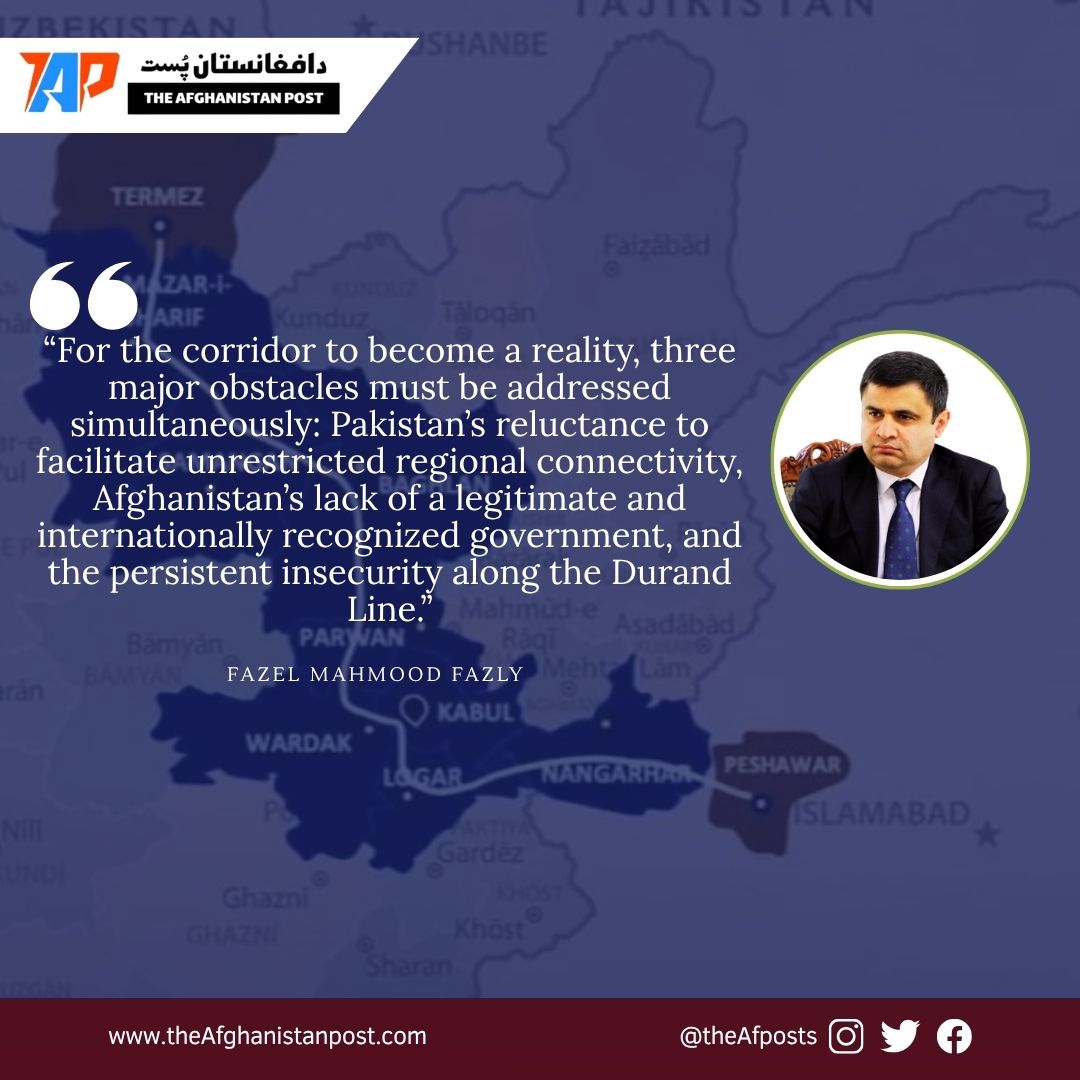
For the corridor to become a reality, three major obstacles must be addressed simultaneously: Pakistan’s reluctance to facilitate unrestricted regional connectivity, Afghanistan’s lack of a legitimate and internationally recognized government capable of providing the guarantees that major investors require, and the persistent insecurity along the Durand Line caused by extremist militant groups nurtured and supported by Pakistan’s security establishment.
By:
Dr. Fazel Mahmood Fazly, former Senior Chief Adviser to the President of Afghanistan and former Director General of Administrative Affairs of the Islamic Republic of Afghanistan