

March 9, 1989, The evening broadcast of the BBC Afghan Service: “The Mujahideen have reached within one kilometer of Jalalabad city. The city is on the verge of collapse. In the past 24 hours alone, more than 5,000 rockets have been fired at the city, and its defensive lines have collapsed.”
On the frontlines, the fighting was fierce and relentless but just as intense was the propaganda war. Media outlets supporting the U.S.-backed jihad amplified narratives designed to shape perception. Rumors spread among the residents of Jalalabad that on March 10, General Hamid Gul, the former head of Pakistan’s ISI, would pray the afternoon prayer in the city’s White Mosque alongside Afghan militia leaders and Arab fighters.
Amid hunger, starvation, rockets and deaths, perhaps the most terrifying weapon was fear itself carefully manufactured and broadcast to break the souls of civilians.
When I see images of the siege of Gaza today, its destruction and its casualties, I am instantly taken back to Jalalabad. Anyone who lived through that siege can deeply understand what people in Gaza are experiencing now.
At the time, Jalalabad was surrounded from all sides. I was a sixth-grade student then. All the schools were closed. Mothers kept their children hidden in basements to protect them from rocket fire. Every resident of the city had witnessed, in their own street, the aftermath of explosions, pieces of a child’s body or a mother torn apart.
Back then, the city covered only about two square kilometers. After the fall of Kunar, many displaced people had also fled there. Jalalabad was home to Muslims, Hindus and Sikhs alike, yet its population was only around 50,000 as many had already fled to Kabul or Peshawar before the siege began.
From March to July 1989, thousands of rockets rained down on this small area every single day. Among them were cluster-type missiles, which exploded into smaller bomblets, each detonating separately multiplying civilian casualties.
There was not only hunger and famine, but also a severe lack of medical care. Food convoys sent from Kabul were looted along the highway. Smuggling even a small amount of cooking oil into the city could cost you your life. People shared what little food they had with neighbors.
Treating the wounded was almost impossible. Due to the lack of anesthesia, many injuries were stitched without any pain relief. Amputations became common, not because they were ideal but because there were no means for long-term treatment. Even funerals were small; only a few people could attend.
Just as today we see some extremists celebrating the killing of Palestinian women and children in Gaza, during the Jalalabad war there were similar scenes. In hotels and halls in Peshawar and Islamabad, Western and Arab journalists, NGO officials and their Afghan associates, who had come to cover the war, were surrounded by an atmosphere of celebration. Offices of militant groups and NGOs in Peshawar and Quetta held gatherings as if a great victory was imminent.
Many of these Western journalists enthusiastically praised the rocket bombardment of Jalalabad. Civilian deaths were framed as signs of success. The siege, the starvation, it was all presented as a “successful military tactic.”
In this way, the war in Jalalabad resembles the tragedy of Gaza not only in its suffering, but also in how it was reported.
On one side of the battle were approximately 12,000 fighters from seven Mujahideen factions, 5,000 operatives from two ISI brigades, around 1,300 Arab fighters, and an unknown number of U.S. and Western intelligence personnel equipped with Western funding and logistics. Their goal was to break the city’s defenses.
On the Afghan side, about 15,000 Afghan defenders stood alone.
After six months of intense resistance, the defenders of Jalalabad, entirely Afghan, without a single foreign fighter successfully repelled the US, Pakistani, Arab and proxies’ assault. It was a humiliating defeat for the proxy forces, one that some still attempt to downplay or reinterpret to this day.
The same three groups proxy militias, media and NGOs, that once contributed to destruction and suffering were later rebranded. After 2000, they were presented as champions of “democracy,” “human rights,” and “freedom of speech.”
Their influence, backed by massive funding, has been so overwhelming that it has blocked the emergence of genuine political movements. As a result, people focus on individuals labeling one a hero and another a traitor while ignoring the real issue: the policies and strategies of powerful states that deploy these individuals.
For example, recent controversial remarks by the wife of a former U.S. envoy to Afghanistan sparked outrage. Some NGO activists even demanded legal action against her. But such reactions miss the bigger picture.
Figures like Zalmay Khalilzad and his wife are not independent actors, they operate within the framework of U.S. policy. In the 1980s, they supported the siege of Jalalabad. After 2000, they spoke of human rights and democracy. Today, they may justify restrictions on women’s rights. Tomorrow, they could once again support armed resistance under a different narrative.
If that happens, will the same critics and our liberals begin praising them (US policies) again?
If we truly want to understand our tragedies, we must shift our focus from individuals to the governments and policies behind them.
Despite their current hardships, Palestinians maintain a strong sense of national awareness. They do not place blame on individuals alone, but on global power structures. Their struggle is long, organized and ideological and they have not abandoned it.
We, on the other hand, often lack such organization and long-term vision. The “NGO mindset” has conditioned us to think in short-term projects, to interpret national tragedies through the language of funding cycles and crisis management.
But there is only one real path forward: a political process.
And that process begins with historical memory. Societies naturally forget but preserving, analyzing and building narratives from history is the responsibility of political organizations and states.
Even if a strong national state does not exist today, the space for building political organizations still does. Instead of reacting daily to headlines, we should engage in sustained dialogue with like-minded people, dialogue that leads to clear outcomes and gradually forms the foundation of independent, ideological movements.
Movements that are not dependent on foreign funding.
Because without independence, we will remain trapped praising and condemning individuals while losing sight of the bigger picture.
We can learn not only from our own history but also from the experiences of other oppressed people, the Kurds, Palestinians, Baloch and others. These are small but vital steps toward building a meaningful political future.
If we fail to take them, tragedies like Jalalabad may repeat themselves.
We must move beyond emotional reactions and toward deeper political understanding, an understanding that recognizes the nature of regional and global power and lays the foundation for a stable political path forward.
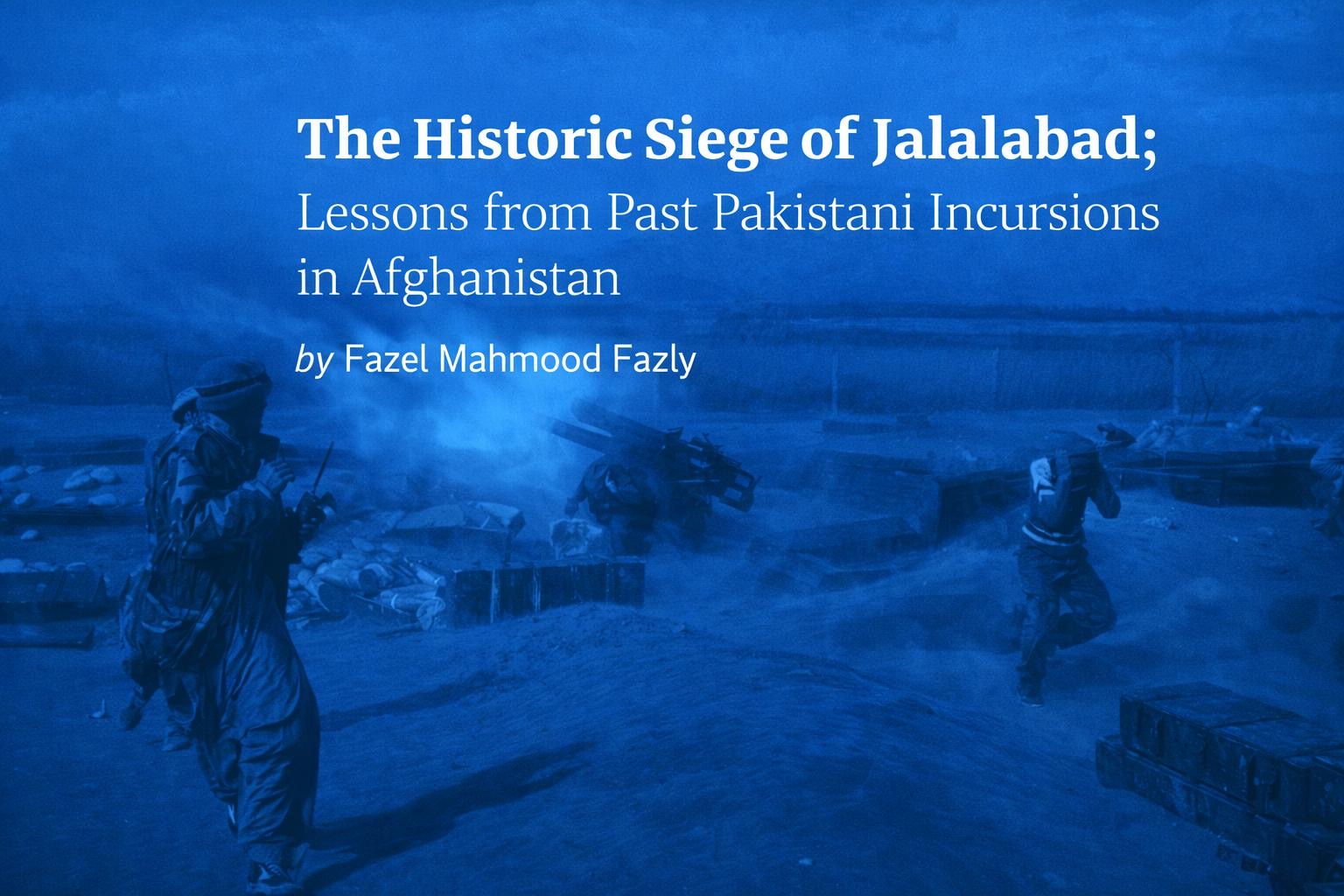
Photo: Taken by Patrick Durand on the frontlines of the Jalalabad war, March 18, 1989.